Industrial Razor Blades: A Complete Guide to Film Slitting and Converting Blades
Industrial razor blades are precision cutting tools used to slit, trim, separate, and convert materials such as plastic film, foil, paper, fiber, textiles, food products, and flexible packaging. Unlike ordinary utility blades, industrial blades are engineered for demanding production environments where cut quality, consistency, blade life, and equipment compatibility directly affect productivity.
Choosing the correct blade can reduce dust, material tearing, unplanned downtime, and waste. The best solution depends on the material being processed, line speed, blade holder, cutting method, required edge quality, and operating conditions.
With more than 50 years of industry experience, Hardedge Tool supplies stock and custom cutting solutions for manufacturers and converters. This guide explains the principal blade styles, materials, coatings, and selection factors industrial buyers should understand.
What Is an Industrial Razor Blade?
An industrial razor blade is a thin, precision-manufactured cutting tool designed for continuous or repetitive use in industrial machinery. These blades are commonly mounted in slitting, converting, packaging, textile, reclaim, and core-cutting equipment.
Common industrial razor blade applications include:
- Slitting plastic film and flexible packaging
- Cutting paper, foil, and laminated materials
- Trimming fibers and textiles
- Processing tapes and adhesive-backed products
- Cutting cores used for rolls and reels
- Pelletizing and reclaim operations
- Producing narrow rolls from wider webs
- Trimming excess material during manufacturing
Industrial blades are available in numerous dimensions, mounting configurations, edge geometries, substrates, and coatings. Even small differences in blade design can significantly influence cutting performance.
What Is Razor Slitting?
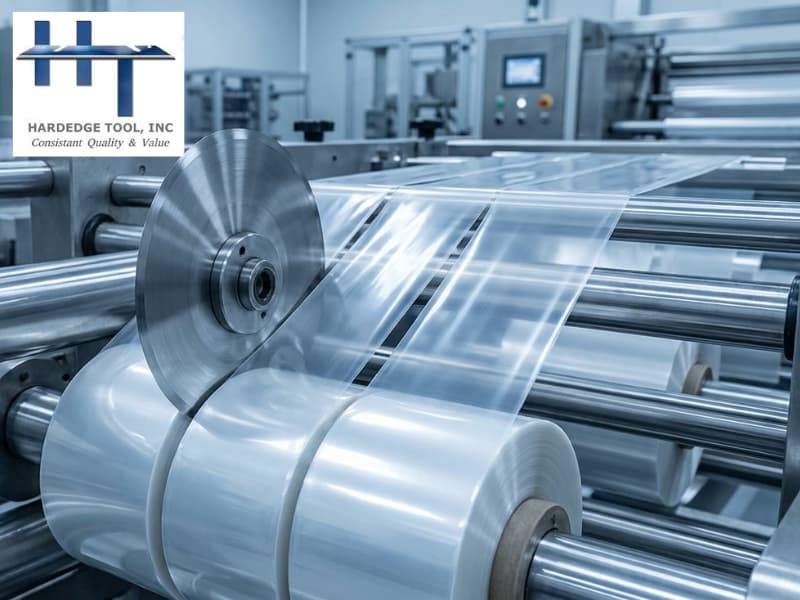
Razor slitting is a converting process in which a sharp blade penetrates a moving web of material and divides it into narrower widths. The method is frequently used with relatively thin materials, including plastic films, foil, paper, and flexible packaging.
Razor slitting can provide several advantages:
- Simple blade installation
- Precise cuts on suitable materials
- Minimal tooling requirements
- Efficient operation at production speeds
- Economical blade replacement
- Compatibility with many thin webs
Results depend heavily on blade sharpness, alignment, material characteristics, web tension, holder condition, and machine setup. A blade that performs well on one film may wear quickly or create poor edges on another.
Common Film Slitting Blade Styles
Two widely used configurations are precision slotted blades and three-hole blades.
Precision slotted razor blades
Slotted slitter blades contain an elongated center opening that allows the blade to be mounted and positioned in a compatible holder. Options can include square-corner and rounded-corner designs.
These blades are available in materials such as high-speed steel, stainless steel, solid tungsten carbide, and solid ceramic zirconia. Coated versions are also available for applications that require additional wear resistance.
Three-hole and Euro-style blades
Three-hole slitter blades use a recognizable mounting pattern and are found in many converting operations. They are available in steel, coated steel, and solid-carbide configurations.
Always confirm the blade’s length, width, thickness, hole pattern, slot dimensions, edge style, and holder compatibility before ordering. Selecting a blade based only on its general appearance can result in an incorrect fit.
Steel, Coated, Carbide, or Ceramic?
Blade composition is one of the most important factors affecting durability, toughness, sharpness, and cost.
High-speed and stainless steel
Steel blades are versatile and economical. They can provide excellent cutting performance in applications where extreme wear resistance is unnecessary. Steel is generally more tolerant of impact and flexing than brittle materials, although performance varies by grade and blade design.
Ceramic-coated steel
Ceramic coatings increase the surface hardness and wear resistance of a steel blade while retaining the supporting properties of the underlying substrate. Hardedge Tool offers standard ceramic, boron-carbide ceramic, and titanium-carbide ceramic-coated options.
A coated blade may be beneficial when an uncoated blade loses its edge too quickly but a solid-carbide blade is unnecessary for the application.
Solid tungsten carbide
Solid tungsten carbide slitter blades offer strong wear resistance and edge retention. They can be an effective choice for abrasive materials or operations where frequent blade changes create costly downtime.
Carbide is harder but generally more brittle than steel. Proper handling, mounting, and machine alignment are important because impact or excessive side loading may damage the blade.
Solid ceramic zirconia
Solid ceramic zirconia blades offer corrosion resistance and long-lasting cutting performance in compatible applications. Because ceramics behave differently from steel, they must be evaluated according to the material, machine, holder, and possibility of impact.
No single blade material is best for every production line. The most economical choice is the blade that delivers the required cut quality at the lowest total operating cost.
How to Choose the Right Industrial Razor Blade
Begin by documenting the complete application rather than simply reordering the blade currently installed.
Important selection factors include:
- Material: Identify the exact film, foil, paper, textile, laminate, or fiber being cut.
- Thickness: Thin films and thicker materials place different demands on the cutting edge.
- Material properties: Abrasive additives, adhesives, coatings, and recycled content may accelerate wear.
- Cutting speed: Higher speeds can magnify heat, vibration, alignment, and edge-quality problems.
- Blade dimensions: Confirm every measurement and mounting feature.
- Edge geometry: Bevel style and cutting-edge design affect penetration and material displacement.
- Quality requirements: Determine the acceptable levels of dust, burrs, deformation, and edge inconsistency.
- Blade-change frequency: Calculate how often production stops for replacement.
- Machine setup: Inspect holders, alignment, web tension, and blade positioning.
- Safety requirements: Establish suitable handling, storage, installation, and disposal procedures.
Providing a used blade, technical drawing, equipment model, material sample, or detailed application description can help a blade specialist recommend the correct solution.
Why Do Slitter Blades Wear Out Quickly?
Premature blade wear is not always caused by poor blade quality. Frequent causes include:
- Abrasive or filled materials
- Incorrect blade substrate or coating
- Adhesive buildup
- Damaged blade holders
- Improper alignment
- Excessive vibration
- Side loading
- Material contamination
- Inappropriate edge geometry
- Continuing production after the edge becomes damaged
Warning signs include increasing dust, ragged edges, film dragging, inconsistent slit widths, material tearing, additional cutting force, and more frequent web breaks.
Replacing a worn blade may solve the immediate problem, but repeated failures require a broader review of the cutting process.
Calculate Cost per Cut—not Just Blade Price
The least expensive blade is not necessarily the most economical. Manufacturers should consider blade cost alongside productive blade life, downtime, labor, scrap, rework, and finished-edge quality.
A higher-performance coated or carbide blade may cost more initially but reduce total expenses if it lasts longer and minimizes blade changes. Conversely, a premium blade offers little value if a lower-cost steel option already meets all production requirements.
Testing different options under controlled conditions is the most reliable way to compare performance.
Get Help Selecting Your Next Blade
Hardedge Tool provides industrial razor blades, film slitting blades, converting blades, circular blades, shear and score blades, core-cutting blades, injector blades, textile blades, and custom cutting solutions. Stock items typically ship within one business day, while custom lead times depend on the required specifications.
Whether you need to identify an existing blade, improve edge quality, reduce blade changes, or solve a difficult cutting problem, Hardedge Tool can analyze the application and recommend an appropriate solution.
Contact Hardedge Tool at 859-581-0770 to discuss your material, equipment, blade dimensions, and performance goals.
Frequently Asked Questions
What are industrial razor blades used for?
They are used to slit and trim film, foil, paper, flexible packaging, fibers, textiles, tapes, laminates, and other industrial materials.
Which film slitting blade lasts the longest?
Blade life depends on the material, speed, setup, holder, coating, and required cut quality. Carbide or ceramic options may provide longer wear in suitable applications, but no material is universally best.
Can industrial blades be sharpened?
Many circular, shear, score, core, and special-purpose blades can be sharpened or reconditioned. Thin disposable razor blades are typically replaced instead. Hardedge Tool can determine whether a particular blade is suitable for reconditioning.
What information is needed to order a replacement blade?
Provide the blade dimensions, thickness, mounting pattern, edge configuration, current material or coating, machine model, and material being cut. A drawing, clear photograph, or physical sample can also help identify the correct blade.
Guide to Film Slitting and Converting Blades
Blog by Foster Group