Industrial Razor Blades: A Complete Guide to Film Slitting and Converting Blades
Industrial razor blades may be small, but they can have an enormous effect on converting productivity, finished-product quality, and operating costs. Selecting the wrong blade can contribute to poor edge quality, excessive blade changes, material waste, and unwanted downtime. The right blade can deliver cleaner cuts, longer service life, and more consistent performance.
Hardedge Tool supplies high-performance industrial razor blades, film slitting blades, and converting blades for applications involving film, foil, paper, fiber, food products, and flexible packaging. With more than 50 years of industry experience, we help manufacturers identify cutting solutions suited to their materials, equipment, and production goals.
This guide explains how industrial slitting blades work, what materials and coatings are available, and how to select an appropriate blade for your operation.
What Is an Industrial Razor Blade?
An industrial razor blade is a precision cutting component used in manufacturing and converting machinery. Unlike a consumer shaving blade, it is engineered to cut or slit materials continuously at production speeds.
Common applications include:
- Plastic film slitting
- Flexible packaging conversion
- Paper and foil processing
- Fiber and textile cutting
- Food-processing operations
- Pelletizing and material reclaim
- Core cutting
- Specialty converting processes
Industrial razor slitting is frequently used when a manufacturer needs narrow rolls, clean edges, or accurate widths. The blade is positioned so the moving web passes across its cutting edge, separating the material as it travels through the machine.
Blade geometry, edge sharpness, material composition, coating, alignment, and operating conditions all influence the quality of the cut.
How Do You Choose a Film Slitting Blade?
To choose a film slitting blade, begin with the material being cut. You should also evaluate material thickness, abrasiveness, operating speed, blade-holder design, required edge quality, and expected production volume.
Ask these questions before selecting a blade:
- What material will be slit?
Thin plastic film may require a different cutting edge than foil, paper, fiber, or multilayer packaging. - How abrasive is the material?
Abrasive substrates and additives can wear standard blade edges more quickly, making coated or solid carbide blades worth considering. - Which blade configuration fits the machine?
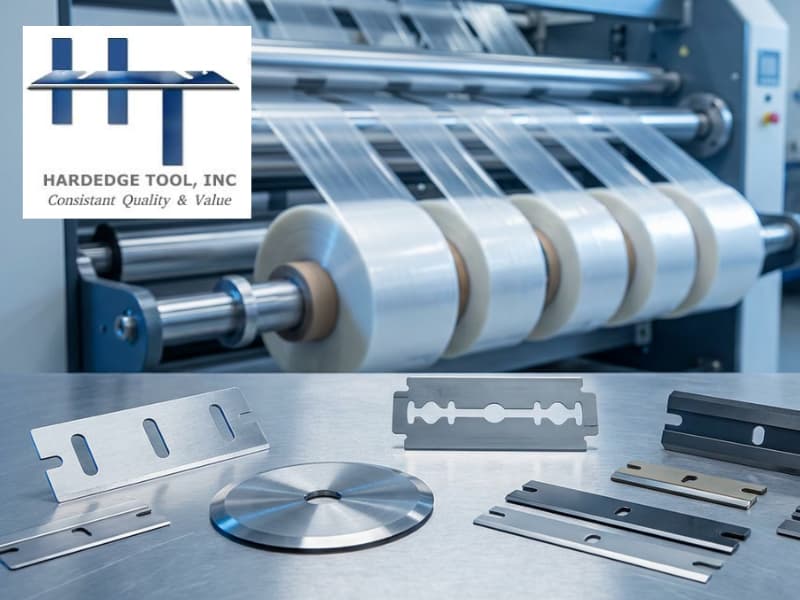
Common configurations include slotted razor blades, three-hole or Euro-style blades, injector blades, circular blades, and specialty designs. - What is causing the current blade to fail?
Premature dulling, chipping, contamination, heat, poor edge quality, and frequent changeovers may point to different solutions. - What matters most: initial price or total cutting cost?
A longer-lasting blade may reduce downtime and labor, even if its purchase price is higher.
A cutting specialist can help compare these factors instead of treating every slitting application as identical.
Slotted vs. Three-Hole Razor Slitter Blades
Two widely used options in converting operations are precision slotted razor blades and three-hole razor slitter blades.
Precision slotted razor blades
Slotted blades are designed for compatible holders that secure the blade through its center slot. They are available in several materials and edge configurations, including high-speed steel, coated stainless steel, solid tungsten carbide, and solid ceramic zirconia.
Depending on the equipment, a slotted blade may have squared or rounded corners. Confirming holder compatibility and dimensions is essential before ordering.
Three-hole or Euro razor blades
Three-hole blades use a recognizable mounting pattern and are common in film and flexible packaging equipment. Options include stainless steel, ceramic-coated stainless steel, titanium carbide ceramic-coated designs, and solid carbide blades.
The best configuration is not determined by shape alone. Blade material and coating should also match the substrate and operating environment.
Understanding Blade Materials and Coatings
Industrial blade materials have different combinations of sharpness, toughness, wear resistance, and cost. Hardedge Tool offers several options for slitting applications.
High-speed steel
High-speed steel provides a useful balance of toughness and cutting performance. The HT HSS-10 high-speed steel slotted razor is one option for operations seeking dependable performance in a precision slotted format.
Stainless steel
Stainless steel razor blades are versatile and available in multiple shapes. They can be appropriate for many converting applications, particularly when paired with a coating selected for the cutting challenge.
Standard ceramic coating
A ceramic coating can improve surface and wear characteristics compared with an uncoated blade in suitable applications. Actual blade life depends on the material, machine settings, speed, and edge exposure.
Boron carbide ceramic coating
Boron carbide ceramic coatings are intended for applications that require additional resistance to wear. They may help operations experiencing rapid edge degradation, although testing under real production conditions remains important.
Titanium carbide ceramic coating
Titanium carbide ceramic-coated blades combine a steel blade body with a wear-resistant cutting surface. Hardedge Tool offers titanium carbide options in both slotted and three-hole configurations.
Solid tungsten carbide
A solid tungsten carbide slitter blade provides high wear resistance and can be a strong choice for demanding or abrasive applications. Because carbide behaves differently from steel, proper installation and handling are important.
Solid ceramic zirconia
Solid ceramic zirconia blades offer excellent resistance to corrosion and wear in compatible applications. Ceramic blades can provide long cutting life, but they should be handled carefully to prevent chipping or impact damage.
Why Blade Selection Affects Total Production Cost
The least expensive blade is not always the lowest-cost option. Manufacturers should consider the complete cost of cutting, including:
- Frequency of blade replacement
- Machine downtime
- Operator labor
- Material scrap
- Inconsistent roll widths
- Poor or damaged edges
- Blade-related quality complaints
- Inventory requirements
For example, a coated or solid-material blade that lasts longer may reduce changeovers. Fewer blade changes can improve machine availability and help operators maintain more consistent output.
Performance should be measured using actual production data. Track blade life, linear footage cut, downtime, scrap, and finished-edge quality. This creates a reliable comparison between blade types.
Signs That Your Slitting Blade Needs Attention
A blade may need replacement, sharpening, reconditioning, or further analysis when operators notice:
- Ragged or uneven edges
- Increased dust or debris
- Film stretching instead of cutting cleanly
- Frequent web breaks
- Greater cutting force
- Burrs, tears, or edge distortion
- Reduced blade life
- Inconsistent results across the web
Not every cutting problem is caused by the blade. Blade alignment, holder condition, web tension, machine vibration, contamination, and process speed should also be inspected.
Many industrial blades can be sharpened or reconditioned multiple times. Professional blade sharpening can extend useful life and help maintain consistent performance when the blade design and condition allow it.
Work With an Experienced Industrial Blade Supplier
Successful converting requires more than ordering a blade with the correct dimensions. It requires analyzing the substrate, machinery, production environment, and business objectives.
Hardedge Tool follows a process built around:
- Analysis of the cutting application
- Design based on operational requirements
- Manufacturing for precision and consistency
- Testing for durability, reliability, and performance
Stock items typically ship within one business day, while custom blade lead times depend on the specifications. Custom solutions are available for cutting requirements that cannot be addressed with a standard blade.
Film Slitting and Converting Blades – Improve Your Film Slitting and Converting Process
Choosing the right industrial razor blade can improve edge quality, reduce interruptions, and support more efficient converting. The ideal solution may be a precision slotted razor, a three-hole blade, a ceramic-coated design, or a solid tungsten carbide or zirconia blade.
Hardedge Tool provides stock and custom cutting solutions backed by more than five decades of industry expertise. Our team serves manufacturers working with film, foil, flexible packaging, paper, fiber, food products, and other industrial materials.
Need help selecting a film slitting or converting blade? Contact Hardedge Tool at 859-581-0770 to discuss your material, equipment, and cutting requirements.
Frequently Asked Questions
What blade is best for slitting plastic film?
The best blade depends on the film composition, thickness, additives, production speed, equipment, and required edge quality. Stainless steel, coated steel, tungsten carbide, and ceramic zirconia may each be suitable under different conditions.
Do coated razor blades last longer?
A properly selected coating may improve wear resistance and extend cutting life. Results vary according to the substrate, blade exposure, machine setup, and operating conditions.
Can industrial slitter blades be sharpened?
Many blade designs can be sharpened or reconditioned multiple times. The blade material, geometry, wear, and physical condition determine whether reconditioning is practical.
Does Hardedge Tool provide custom converting blades?
Yes. Hardedge Tool designs and manufactures custom cutting solutions for specialized industrial requirements in addition to supplying stock blades.
Blog by Foster Group