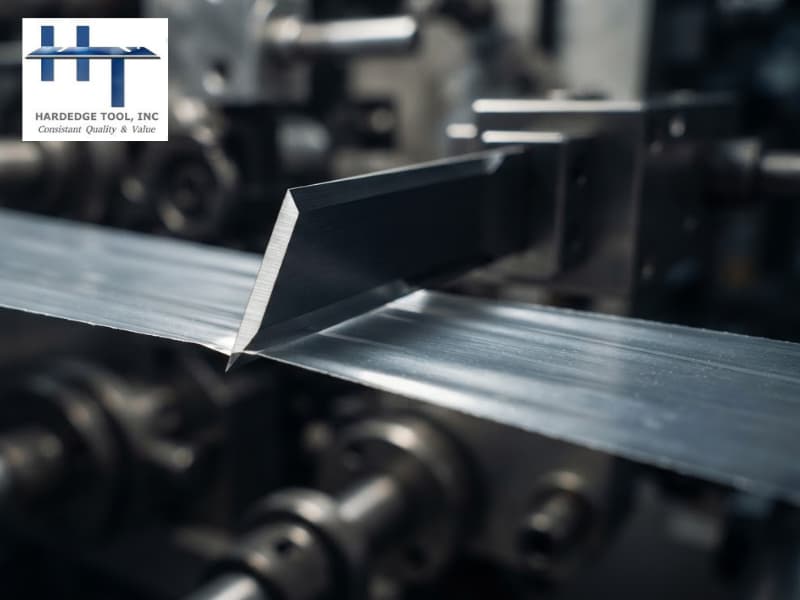
Industrial razor blades are precision cutting tools used for repetitive production work where edge quality, dimensional accuracy, and machine compatibility affect results. Manufacturers and converters use these blades to slit, trim, separate, and process plastic film, foil, paper, fiber, textiles, food products, and flexible packaging.
At Hardedge Tool, our team brings more than 50 years of industry experience to precision cutting applications. Our process starts with the material, equipment, cutting method, and required result. This application-focused approach helps manufacturers select blades that support clean edges, consistent output, and dependable production.
What Are Industrial Razor Blades?
Industrial razor blades are thin, precision-manufactured cutting tools designed for repetitive or continuous production applications. They are commonly used for slitting, trimming, separating, and converting materials such as film, foil, paper, fiber, textiles, tapes, and flexible packaging.
Unlike general-purpose utility blades, industrial razor blades are selected according to the material being processed, blade dimensions, edge geometry, mounting configuration, cutting speed, and required cut quality. Hardedge Tool supplies industrial blades in multiple configurations, including slotted, injector, three-hole/Euro, circular, score, core, pelletizer, and fiber textile designs.
Industrial Blade Types for Slitting and Converting
Slotted Razor Blades
Slotted razor blades are common in industrial slitting because the slot configuration supports compatible holders. Stainless steel versions suit many applications, while coated options can provide additional wear resistance. Confirm dimensions, corner style, and coating before ordering.
Injector and Utility Blades
Injector and utility blades support compact cutting applications requiring controlled geometry and secure mounting. Options include stainless steel, titanium carbide-coated stainless steel, and tungsten carbide. Match the blade to the holder, substrate, and operating conditions.
Three Hole Euro Blades
Three-hole Euro blades use a recognizable mounting pattern found across many converting operations. Available configurations include stainless steel, coated steel, tungsten carbide, and ceramic zirconia. Multiple thicknesses and corner styles make exact dimensional verification important.
Circular and Score Blades
Circular and score blades serve rotary and scoring applications. Designs can use high-speed steel or D-2 steel and differ in diameter, thickness, keyway, and bevel. Matching the geometry to the machine helps maintain stable cutting contact.
Core, Pelletizer, and Fiber Textile Blades
Core cutter blades support roll and reel processing, while pelletizer and fiber textile blades serve specialized requirements. Each application can demand different edge strength, wear resistance, and geometry. Our team also develops specialized solutions for nonstandard requirements.
Industrial Blade Materials and Coatings
High Speed and Stainless Steel
High-speed steel provides strong edge performance for many cutting tasks, while stainless steel offers useful corrosion resistance. Selection should consider substrate, speed, exposure, impact risk, and service life.
Ceramic Coated Steel
Ceramic coatings can provide additional wear resistance and durability in applications where an uncoated blade does not provide the required service life. Available options include standard ceramic, boron carbide ceramic, and titanium carbide ceramic coatings. Coated steel can suit applications where an uncoated edge wears too quickly.
Solid Tungsten Carbide
Solid tungsten carbide provides high hardness and strong wear resistance. It can suit demanding applications where edge retention matters and frequent blade changes affect production. Proper mounting and alignment remain important because carbide can be sensitive to impact.
Solid Ceramic Zirconia
Solid ceramic zirconia can provide corrosion resistance and durable cutting performance in compatible applications. Because ceramic behaves differently from metal, review impact, flexing, mounting conditions, and alignment before selection.
How Do You Choose the Right Industrial Razor Blades?
Start with the complete cutting application instead of matching the appearance of an existing blade. Differences in thickness, edge geometry, substrate, coating, or mounting features can change performance.
Important selection factors include:
- Exact material and substrate
- Material thickness and construction
- Abrasive additives, adhesives, coatings, or recycled content
- Machine speed and cutting conditions
- Blade dimensions and mounting pattern
- Edge geometry, bevel, and corner configuration
- Required cut quality and wear rate
A drawing, photograph, or physical sample can help identify an existing blade. Confirm dimensions, edge style, and holder compatibility before ordering.
Blade Sizes, Dimensions, and Edge Geometry
Blade size involves more than length and width. Thickness can influence stiffness and interaction with the substrate, while mounting holes and slots must align with the holder.
Product specifications vary across blade categories. Three-hole Euro blades use several thicknesses, while slotted and injector blades use different dimensions. Square and rounded corners can also affect fit.
Industrial Blade Applications Across Manufacturing
Film and flexible packaging often require clean slitting. Paper and foil can demand sharp, consistent edges at production speed, while fiber and textile work can place greater emphasis on durability.
At Hardedge Tool, our team serves film, foil, food, paper, fiber, and flexible packaging applications. Specialized solutions can also address production requirements outside standard blade configurations.
What Should You Check Before Ordering Replacement Blades?
Gather the machine model, blade dimensions, mounting pattern, thickness, edge configuration, substrate, coating, production speed, and primary cutting problem before ordering.
Our team can review application details and help identify a suitable configuration. Stock items are typically shipped within one business day, while custom lead times depend on specifications.
Find the Right Industrial Cutting Blade for Your Application
Contact our team at Hardedge Tool to discuss your application, review blade specifications, and identify the right solution for your operation.